

NAWRS Events

September TANF Data Huddle: Data Visualization Round Robin
Please join us for our September TANF Data Huddle! A complete agenda will be provided later but tentatively we are planning multiple participant presenters who will each briefly share a visual or dashboard that they think was done well or is interesting to share in other ways. Possible points of discussion:
Process for creating it
Successes
Struggles
Who’s using it and how often
If you have a visual or dashboard you are interested in sharing, please reach out to Rich Spindler at richardp.spindler@wisconsin.gov. Thank you!
Reminder: As usual, our TANF Data Huddles are the 3rd Wednesday of each month.
Time: 1:00 - 1:55 Central Time
Interested in joining? Email secretary@nawrs.org to sign up for meeting invitations!

Lived Expert Engagement Technical Assistance Session
NAWRS is delighted to partner with the National Research Agenda for an interactive virtual learning opportunity. We invite you to join our Lived Expert Technical Assistance (TA) Session, where we host time for the group to apply the field's leading frameworks—the Equitable Compensation Taskforce Report and the PLE Planning Worksheet—as actionable strategies for your team. Authentic systems reform requires building true professional partnerships with People with Lived Expertise (PLEs). A Lived Expert is an individual who has direct, personal experience navigating public systems such as foster care, TANF, supportive housing, family separation, or other aspects of the child welfare or other human resources system (Casey Family Programs, 2023).
Date: Tuesday, September 15, 2026 Time: 9am-10am Pacific Time
Session Link: https://casey.zoom.us/meeting/register/nlscbbidSXy3KXI9U1YKLA
Key Benefits of the Session
Planning the lived Exert Engagement
Equitable & Sustainable Compensation: Learn to set competitive hourly rates, streamline fast payments, and protect partners from the "benefits cliff”.
Authentic Power-Sharing: Shift roles from basic consultants to co-leaders, identify and address team biases, and establish clear scopes of work.
Data Sovereignty & Diversity: Structure project frameworks that honor community intellectual property and bring in diverse lived perspectives.
If you have any questions, please reach out to Alexandria Maldonado (alexm@fosterclub.com), Project Coordinator & Research Analyst for the National Research Agenda.

Strategies for Utilizing Research Findings for Policy, Program Design and Practice in Child and Family Social Services: A Synthesis of the Literature
Presenters from Casey Family Programs will describe 10 strategies for maximizing the likelihood that research findings will be used to inform policy, program design, and practice. The recommendations were derived from the growing body of literature on the strategies for research utilization in child and family social services. The presenters will also engage the audience to discuss which of the strategies they have used and with what kinds of success. The workshop handouts will be derived from a new journal article: Strategies for Utilizing Research Findings for Policy, Program Design and Practice in Child and Family Social Services: A Synthesis of the Literature, published by the Journal of Public Child Welfare.
Actionable strategies are grouped under three categories:
Increase relevance of research
Increase organizational capacity to use research
Increase accessibility of research
Virtual Event Logistics
Date: Monday, August 17, 2026
Time: 9am-10:30am Pacific Time / 12 - 1:30pm Eastern Time
Register: https://casey.zoom.us/meeting/register/ViBdovLxTxaBExrIGgJdIg
After registering, you will receive a confirmation email containing information about joining the meeting.

AI Innovations and Lived Experience in Human Services
The rapidly changing AI environment is creating an urgent need for strong, self‑regulated best practices that balance innovation with human-centered policy.
This session highlights emerging models, including the APHSA, NAVA PBC and State of Maryland AI pilot, which is developing open‑source tools to help caseworkers navigate complex benefit systems and Wonderschool Oversight, which helps agencies detect integrity risk patterns early, prioritize reviews, and manage investigations. Participants will also explore how integrating lived experience into AI design can ensure systems are designed with the communities they serve.

July TANF Data Huddle - Year in Review and Planning Future Topics
Our July TANF Data Huddle with include a short re-cap of the year and sharing of potential session topic ideas through a round-robin and break-out rooms.
Date/Time: Wednesday, July 15 1-2pm Central Time
Virtual Location: Zoom Meeting: https://dcfwi.zoom.us/j/87154550828?pwd=4EEnhi1fnoQ32l9VYTS6SW6iF7C0yh.1
Meeting ID: 871 5455 0828
Passcode: 391892

Navigating the Cliff: Engineering Economic Mobility A Virtual Conversation on the Benefits Cliff Effect
Increasing earnings should lead to greater stability—not a sudden loss of critical supports. Yet many individuals and families experience a “benefits cliff,” where modest income gains can result in a disproportionate loss of public assistance, making economic mobility harder to sustain.
Join us for an important virtual discussion, hosted by APHSA and National Association of Welfare Research and Statistics (NAWRS), to explore policy solutions, workforce pathways, and lived experiences connected to the benefits cliff effect and strategies to help families move beyond it.
Featured Discussion Topics:
APHSA’s Benefits Cliff Resource Hub and innovative state policy strategies
Workforce pathways in clean energy jobs
Real-world experiences navigating and overcoming the cliff effect
Strategies to support long-term economic mobility and self-sufficiency
Speakers
Kristen Joyce,Bridge to Prosperity Program Director, Springfield Works
Jenny Taylor, Chief Mission Officer and VP, Career Services, Goodwill of Georgia
Kapria Lee, Senior Policy Associate, Social & Economic Mobility, APHSA

June TANF Data Huddle — Evidence-to-Practice Guides from the Pathways to Work Evidence Clearinghouse
The Pathways to Work Evidence Clearinghouse systematically reviews evidence to discover what works to improve educational attainment, employment, and earnings for people with low incomes. This session will introduce Pathways to Work’s Evidence-to-Practice Guides, which include practice recommendations crafted by a panel of nationally-recognized experts based on a systematic evidence review. It will cover both the development process and the structure and content of the Guides.
Speakers: Allan Porowksi and Brian Freeman, Abt Global
Time: 1:00 - 2:00 Central
Interested in joining? Email secretary@nawrs.org to sign up for meeting invitations!
Concepts and Planning Tools for Authentic Partnership with People with Lived Experience
Since 2020, the Annie E. Casey Foundation, Casey Family Programs, and the William T. Grant Foundation have partnered to revolutionize child welfare. This session presents a National Research Agenda and an Equitable Framework for shifting power dynamics by centering those with Lived Experience. Attendees will gain strategies ensuring Lived Experience partners are compensated as true collaborators, not symbolic participants. We will debut our Capacity Building Tool, an adaptable framework providing actionable steps for teams pursuing bold systems change. Participants will leave with cost-effective resources and a practical roadmap for building a 21st-century well-being system that treats Lived Expertise as a core pillar of systemic change.
Date: June 11, 2026
Time: 10am-11:30am PT; 11am-12:30am MT; 12pm-1:30pm CT; 1pm-2:30pm ET
Meeting Link:
Presenters
Alisha Agee-Cooper received a master’s degree in social work from the University of Washington and has a Clinical Social Work License (LICSW). Alishia works as a Race Equity Social Justice Administrator for the Washington Department of Children, Youth and Families. She is a member of the Birth Parent National Network with the Children's Trust Fund and an alumnus of the Washington State Parent Advisory Council.
She sits on two boards: Tacoma Probono and Rainer Scholars. Alishia is an innovative collaborator who utilizes her lived, educational and professional experience to promote social justice, race equity, and inclusion of those impacted by systems to participate in the solution, aiming to increase positive outcomes for children and families. Alishia has over 13 years of child welfare experience and lived experience as a parent who has been impacted by the child welfare system. She collaborates across sectors to promote the inclusion of lived experts in all child welfare processes from research to employment. She creates space for critical conversations with community members and organizations using a wide lens offering unique perspectives to presenting issues facing the impacts of child welfare on the community.
Robyn Robbins is a Resource/Foster parent from Northern California who has been supporting families and their medically fragile infants in the Child Welfare System for over 20 years. During this time her focus has expanded to include advocacy, training, mentorship and teamwork specifically geared to help create strength based, solution focused practice and policies that allow families to heal and thrive.
At the national level she is actively involved in speaking engagements, trainings and participation in groups such as the National Birth and Foster Parent Partnership and others that focus on relationship building and community collaboration practices that thoroughly embed people with lived experience in order to create successful child and family outcomes. At her local county level she and her birth parent mentor partner have succeeded in creating a partnership program that now functions as a regular unit in their county child welfare department. She thoroughly believes that children and families deserve racial equity and strong loving homes and communities where they will thrive.

May TANF Data Huddle —Surveying attitudes towards TANF and barriers to participation among TANF-eligible individuals
Surveying attitudes towards TANF and barriers to participation among TANF-eligible individuals
Presenter:
Stephanie Peng
California Department of Social Services
Description:
The California Department of Social Services (CDSS) sent surveys to a random statewide sample of 30,000 TANF-eligible SNAP participants to understand their perceptions of TANF and barriers to participating in the program. CDSS wanted to understand the extent to which the participants believe they are eligible, value TANF benefits, are interested in the range of services available under TANF and are potentially deterred from applying by different kinds of administrative burdens. CDSS will present the main insights drawn from over 2,000 survey responses.
Interested in joining? Email secretary@nawrs.org to sign up for meeting invitations!
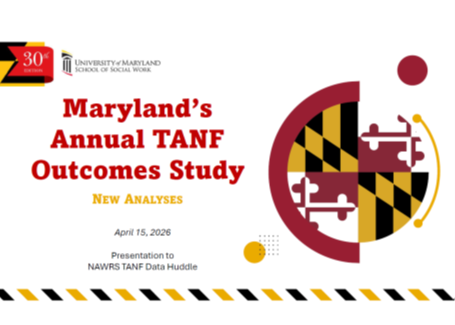
April TANF Data Huddle — Revealing Patterns in TANF Exits: New Insights from Maryland’s Administrative Data
Revealing Patterns in TANF Exits: New Insights from Maryland’s Administrative Data
Presenter:
Lauren Schuyler, PhD
Assistant Research Director, Family Welfare Research
University of Maryland School of Social Work
Description:
Lauren will highlight new findings from Maryland’s TANF program, drawn from linked administrative data, including:
(1) Representation ratios identifying groups that are over- or under-represented in the exiting caseload;
(2) Individual level patterns in how work and earnings changed from before entry to after exit; and
(3) Employment patterns disaggregated by race and ethnicity.
March TANF Data Huddle — Discussion on Translating Research to Practice
Detail: To prepare for this discussion, we ask that participants think of an attempt to translate research into practice that didn’t work. For example, have you brought research findings to leadership that were not used or were under-utilized? Then, think about answers to the following prompts, which we will ask volunteers to share to help start a discussion among the participants on this topic.
Prompt Questions:
What was the research/policy question?
What did you learn?
What did and didn’t happen and why?

January TANF Data Huddle — Sharing of Interests
In break-out rooms, an expression of interests and possible topics to share at a future TANF Data Huddle.
Short introductions.
Are there specific topics you are interested in hearing about?
Are there topics of interest you’d like to share more about (i.e., what you are working on)?
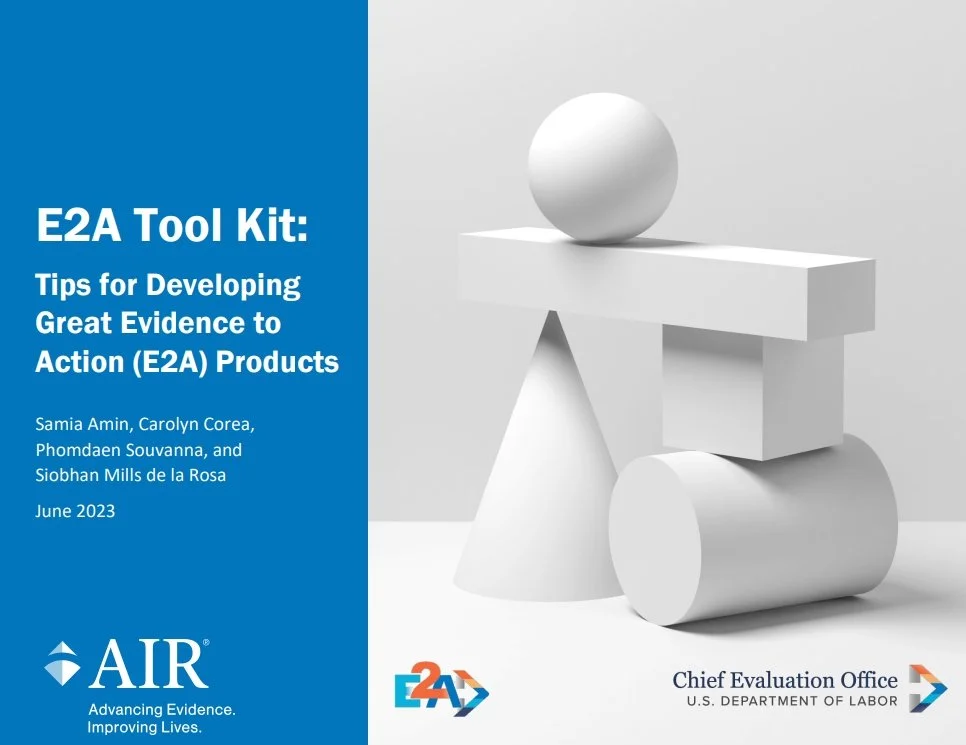
December TANF Data Huddle - Developing Evidence to Action Products
The topic of our October TANF Data Huddle is Developing Evidence to Action Products presented by Samia Amin, American Institutes for Research (AIR).
The TANF Data Huddle brings together TANF data experts to build a network of TANF data professionals, raise and discuss emergent issues in the TANF data space, and exchanging findings, innovations, and approaches. The TANF Data Huddle is open to researchers, practitioners, and data enthusiasts at the federal, state, county, and local levels in public, private, and nonprofit settings. Interested in joining? Email secretary@nawrs.org to sign up for meeting invitations!
November TANF Data Huddle - Emergency Assistance (EA) to Stabilize Housing
The topic of our November TANF Data Huddle is Emergency Assistance (EA) to Stabilize Housing presented by Jake Griffith (State of Wisconsin).
The TANF Data Huddle brings together TANF data experts to build a network of TANF data professionals, raise and discuss emergent issues in the TANF data space, and exchanging findings, innovations, and approaches. The TANF Data Huddle is open to researchers, practitioners, and data enthusiasts at the federal, state, county, and local levels in public, private, and nonprofit settings. Interested in joining? Email secretary@nawrs.org to sign up for meeting invitations!

October TANF Data Huddle - EBT Theft: How to Measure It And What Interventions Can Reduce It
The topic of our October TANF Data Huddle is EBT Theft: How to measure it and what interventions can reduce it presented by Joaquin Carbonell and Konrad Franco, California Dept of Social Services.
The TANF Data Huddle brings together TANF data experts to build a network of TANF data professionals, raise and discuss emergent issues in the TANF data space, and exchanging findings, innovations, and approaches. The TANF Data Huddle is open to researchers, practitioners, and data enthusiasts at the federal, state, county, and local levels in public, private, and nonprofit settings. Interested in joining? Email secretary@nawrs.org to sign up for meeting invitations!

September TANF Data Huddle
NAWRS recently launching its first affinity group! The TANF Data Huddle brings together TANF data experts with the aims of (1) Building a network of TANF data professionals across the country, (2) Providing a forum for TANF data professionals to raise and discuss emergent issues in the TANF data space, and (3) Exchanging findings, innovations, and approaches to analyzing and leveraging TANF data in policy making and practice. The TANF Data Huddle is open to researchers, practitioners, and data enthusiasts at the federal, state, county, and local levels in public, private, and nonprofit settings.
Interested in joining? Email secretary@nawrs.org to sign up for meeting invitations!

NAWRS 2025 Workshop
Please plan to join us for the 2025 NAWRS Workshop in Charlotte, North Carolina from August 3rd-6th. Connect, collaborate, and learn from human services researchers and practitioners dedicated to improving economic mobility and family well-being. Learn more on our 2025 Workshop page.

Centering Family Experiences in Human Services – Incorporating Family Advisory Councils into Service Delivery and Research
Improving alignment between human services and family needs and goals has been a key area of focus for many state and local human services programs. Family advisory councils offer a unique opportunity to facilitate meaningful engagement with families served by public programs; gain family input on policies and practices that affect them; and ultimately, to help develop programs and policies that serve families successfully and equitably. In this session, panelists discussed their experiences developing, launching, and sustaining family advisory councils in policy and research.
View event recording, slides, and resources.

Starting Strong: Providing Income Support to Families During Pregnancy and the First Year of Life
The Research: Income in the First Year of Life Matters
Christal Hamilton, Assistant Professor, University of Connecticut, School of Public Policy will will present on this study: Experiences of Poverty Around the Time of a Birth: A Research Note — Columbia University Center on Poverty and Social Policy.
Rx Kids: “Prescribing Cash to Improve Outcomes in Pregnancy and the First Year of Life
Dr. Mona Hanna-Attisha will talk about the vision and implementation of RxKids – a no strings attached program in Flint Michigan to provide cash to families during pregnancy and the first year of life. More than 700 families are currently enrolled in the program.
Evaluating, Funding and Expanding RxKids
Luke Shaefer, Professor, University of Michigan will talk about how RxKids is being evaluated, how TANF funds are being used (along with foundation funds) to provide cash to families and the plans for expanding a modified RxKids program across the state.

Strategies for Increasing Access to Nutrition Assistance for College Students
The first workshop in the 2024 NAWRS virtual workshop series highlighted strategies state and local SNAP agencies and their partners are employing to improve access to nutrition assistance among college students, an increasingly recognized gap in basic needs support. The workshop featured a discussion of state-level policy at the Colorado Department of Human Services along with their research partner, RAND. It also featured a discussion of a successful SNAP outreach partnership between the Yolo County, California Health and Human Services Agency and UC Davis’s Aggie Compass Basic Needs Center.
A recording of the virtual workshop and presentation slides are available here: Presentation Slides, Workshop Recording